Herman Alfred Leonard Wahlberg E

Stockholm, February 13th 1834 – October 4th 1906, Tranas (Sweden)

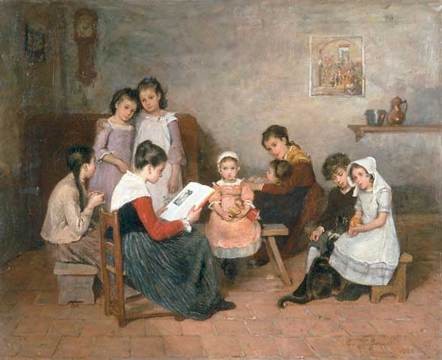
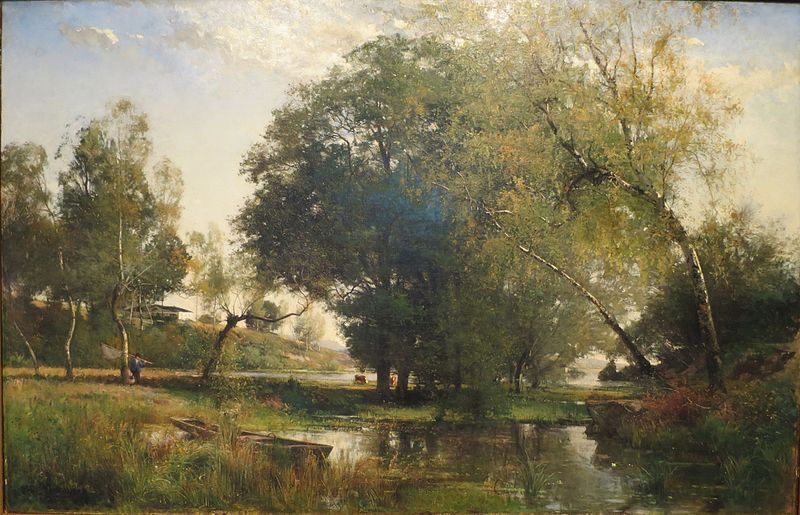
Alfred Wahlberg was born on February 13, 1834, in Stockholm to a painter father and a sculptor mother. After showing an early talent for music, although influenced by his father’s painting, Alfred Wahlberg entered the Royal Academy of Music where he studied piano and clarinet. After his studies, Alfred Wahlberg joined the « Göta Gardes Musikkar » orchestra and gave piano lessons for a living.
After attending the Royal Swedish Academy of Arts, in 1857 he moved to Düsseldorf to enter the Kunstakademic. He was a student in the class of Hans Fredrik Gude (1825-1903).
Before returning to Sweden, he traveled to the Netherlands and Belgium to complete his training. Back in Sweden in 1862, he painted his most famous picture « Svenskt insjölandskap fran Kolmarden« , which is exhibited in the National Museum of Art.
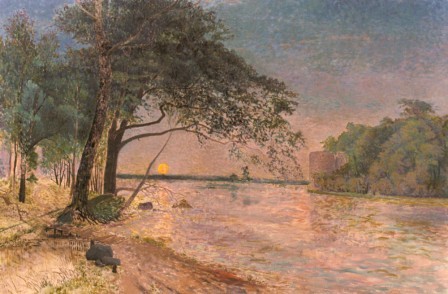
He arrived in Paris in 1866 and participated in the World’s Fair the following year. At the 1868 Salon, he exhibited a sunset « View taken on the coast of Bohulän, Sweden » and a moonlight « View taken at Fjällbacka, on the coast of Bohulän« . He won medals at the Paris Salons of 1870 and 1872.
A specialist in Swedish landscapes, he was present at the 1878 World’s Fair where he received a first class medal. He was named Chevalier de la Légion d’Honneur in 1874 and promoted to Officer in 1878.

In 1896, he lived in rue de Paris, in Ecouen.
The famous writer Théophile Gautier (1811-1872) praised him. He was a friend of Pierre Edouard Frère (1819-1886) in Ecouen as well as of Charles François Daubigny (1817-1878) and Léonide Bourges (1838-1909) in Auvers-sur-Oise. His name is found on an etching by Léonide Bourges dedicated to Daubigny.
Almost every summer, Alfred Wahlberg made short trips to Sweden to study nature.
He died on October 4, 1906 in Tranas (Sweden).


For more information, we invite you to read the book « L’Ecole d’Ecouen – une colonie de peintres au XIXe siècle ».

For further information, please read the book “L’Ecole d’Ecouen, une colonie de peintres au XIXe siècle” (bilingual French-English).
Herman Alfred Leonard Wahlberg

Stockholm, 13 Février 1834 – 4 Octobre 1906, Tranas (Suède)

Alfred Wahlberg est né le 13 Février 1834, à Stockholm, d’un père peintre et d’une mère sculptrice. Après avoir montré un talent précoce pour la musique, bien qu’ayant subi l’influence de son père pour la peinture, Alfred Wahlberg entra à l’Académie Royale de Musique où il y étudia le piano et la clarinette. Après ses etudes, Alfred Wahlberg a rejoint l’orchestre “Göta Gardes Musikkar” et a donné des leçons de piano pour gagner sa vie.
Après avoir suivi des cours à l’Académie Royale Suédoise des Arts, en 1857 il a déménagé à Düsseldorf pour entrer à l’école de peinture Kunstakademic. Il était étudiant dans la classe de Hans Fredrik Gude (1825-1903).

Avant de retourner en Suède, il voyagea aux Pays-Bas et en Belgique pour compléter sa formation. De retour en Suède en 1862, il peignit son tableau le plus connu “Svenskt insjölandskap fran Kolmarden”, exposé au musée National des Arts.

Il arriva à Paris en 1866 et participa à l’exposition universelle l’année suivante. Au salon de 1868, il exposa un soleil couchant “Vue prise sur les côtes de Bohulän, Suède” et un clair de lune “Vue prise à Fjällbacka, sur les côtes de Bohulän”. Il a été médaillé aux Salons de Paris de 1870 et 1872.

Spécialiste des paysages suédois, il fut present à l’exposition universelle de 1878 où il reçut une médaille de première classe. Il fut nommé Chevalier de la Légion d’Honneur en 1874 et promu officier en 1878.

En 1896, il résida rue de Paris, à Ecouen.

Le fameux écrivain Théophile Gautier (1811-1872) fit son éloge. Il a été un familier de Pierre Edouard Frère (1819-1886) à Ecouen ainsi que de Charles François Daubigny (1817-1878) et Léonide Bourges (1838-1909) à Auvers-sur-Oise. On découvre son nom sur une eaux-forte de Léonide Bourges dédiée à Daubigny.

Presque chaque été, Alfred Wahlberg faisait de brefs retours en Suède pour y étudier la nature.
Il est décédé le 4 Octobre 1906 à Tranas (Suède).

Pour plus d’informations, nous vous invitons à lire le livre « L’Ecole d’Ecouen – une colonie de peintres au XIXe siècle »

Cornelia W. Conant E

CORNELIA W. CONANT (Hamilton, NY. Feb. 12, 1834 – NYC April 4, 1919)

Thomas Jefferson Conant (1802-1891) was, without doubt, the greatest American Hebrew scholar of his time. In 1830 he married Hannah O’Brien Chaplin (1809-1865), an American biblical scholar. She effectively assisted her husband in his Hebrew studies.
They had ten children: Roger, Cornelia (or Caroline), Blandina, Carrie (or Chara), Mary, Susan, Marcia, Thomas, Stillman and John.
Stillman S. Conant (1831-1885 ?) became the editor of Harper’s Weekly Magazine from 1869 until his mysterious death in 1885.
In New York, Cornelia W. Conant received painting instruction successively from Daniel Huntington (1816-1906), Edwin White (1817-1877), Joannes A. Oerthel (1823-1909) and other masters.
She studied for four years in Düsseldorf at the Academic Formulas of Carl W. Hübner (1814-1879). From there she sent an important work called « The sacred lesson » which was exhibited at the Goupil Gallery in New York. It was purchased by Mr. Fletcher Harper Jr. and later shown at the Exhibition of the Art Association.
Very few artists arrived with such preparation to make a study trip to France.
The Harper’s Weekly supplement of June 16, 1881 states: « …Miss Conant has lived several years at Écouen, where Edouard Frère is known to be a reference. His inspiration revealed the genius of his pupil… Probably no other American student who has come to France has ever received such generous and unsectarian instruction… Edouard Frere, Luigi Chialiva, Auguste Schenck and other well-known painters reside in Écouen, a village of 1,296 souls located ten miles north of Paris. The cost of living there is very moderate and the artistic craze remarkably vigorous. »
Cornelia W. Conant resided, with her friend and artist Mary L. Stone, at 7 rue de la Beauvette. Their lovely, devoted employee was a village woman named Fanny.
Cornelia W. Conant returned to the same location on August 1, 1896 accompanied by her two sisters Blandina and Carrie.
During her stay in Écouen, she participated in several Paris Salons, exhibiting:
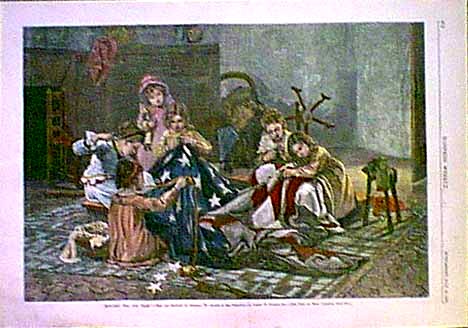
– in 1878, « The Eve of a National Holiday in America
– in 1879, « Family Life
– in 1880, « The end of history
– in 1882, « In the garden ».
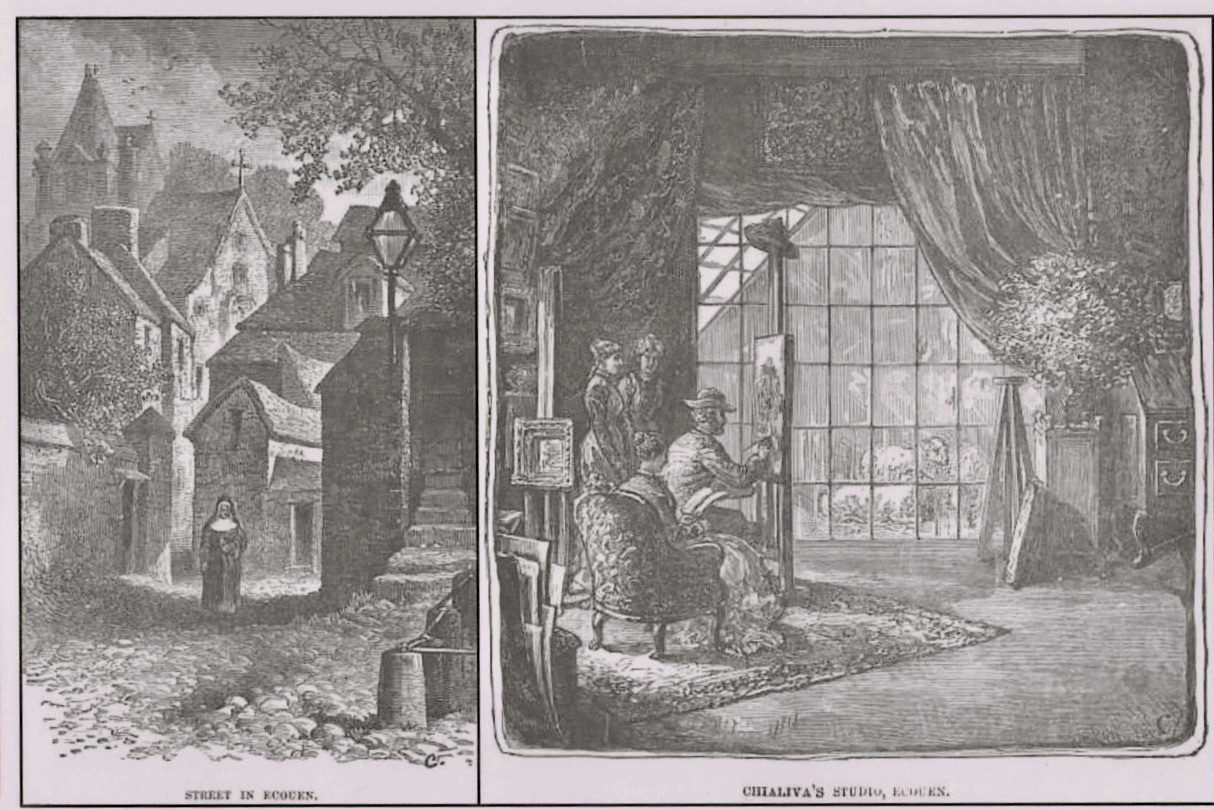
We owe her a double account of her visits to Écouen illustrated by etchings showing the village.
In 1888, Cornelia W. Conant (a watercolor) and Marie L. Stone exhibited at the Museum of Fine Arts.
In 1894, she was a member of the committee of the Department of Paintings of the Brooklyn Institute of Arts and Sciences. She exhibited at the Brooklyn Art Association and the National Academy of Design.
Her painting « The End of History » was included in the 1905 book « Women Painters of the World« .
A funeral service was held for Cornelia W. Conant at St. Peter Episcopal Church on April 4, 1919, when she was in her 86th year.

For further information, please read the book “L’Ecole d’Ecouen, une colonie de peintres au XIXe siècle” (bilingual French-English).
Engravings

Cornelia W. Conant

CORNELIA W. CONANT (Hamilton, NY. 12 février 1834 – NYC 4 avril, 1919)

Thomas Jefferson Conant (1802-1891) était, sans aucun doute, le plus grand érudit américain hébraïque de son temps. En 1830, il épousa Hannah O’Brien Chaplin (1809-1865), une érudite biblique américaine. Elle seconda efficacement son mari dans ses études hébraïques.
Ils eurent dix enfants : Roger, Cornelia (ou Caroline), Blandina, Carrie (ou Chara), Mary, Susan, Marcia, Thomas, Stillman et John.
Stillman S. Conant (1831-1885 ?) devint le Directeur de Harper’s Weekly Magazine de 1869 jusqu’à sa mystérieuse disparition, en 1885.

A New York, Cornelia W. Conant reçut une instruction en peinture successivement de la part de Daniel Huntington (1816-1906), Edwin White (1817-1877), Joannes A. Oerthel (1823-1909) et d’autres maîtres.
Elle étudia quatre ans à Düsseldorf à l’Academic Formulas de Carl W. Hübner (1814-1879). Depuis cet endroit, elle expédia une importante œuvre appelée « The sacred lesson » (La leçon sacrée) qui fut exposée à la galerie Goupil de New York. Elle a été achetée par Mr. Fletcher Harper Jr. et ensuite montrée à l’Exposition de l’Association des Artistes (Exhibition of the Art Association).
Très peu d’artistes sont arrivés avec une telle préparation pour faire un voyage d’études en France.

Le supplément du Harper’s Weekly du 16 Juin 1881 dit : « … Mademoiselle Conant a vécu plusieurs années à Écouen, où Édouard Frère est connu comme étant une référence. Son inspiration a révélé le génie de son élève… Probablement aucun autre étudiant américain venu en France n’a jamais reçu un tel enseignement aussi généreux et dénué de sectarisme… Édouard Frère, Luigi Chialiva, Auguste Schenck et d’autres peintres très connus résident à Écouen, un village de 1296 âmes situé à dix miles au nord de Paris. Le coût de la vie y est très modéré et l’engouement artistique remarquablement vigoureux. »

Cornelia W. Conant résida, avec son amie et artiste Mary L. Stone, au 7 rue de la Beauvette. Leur adorable employée dévouée était une femme du village appelée Fanny.
Cornelia W. Conant reviendra au même endroit le 1er Août 1896 accompagnée de ses deux sœurs Blandina et Carrie.

Durant son séjour à Écouen, elle participa à plusieurs Salons de Paris, y exposant :
– en 1878, « La veille d’une fête nationale en Amérique »
– en 1879, « Vie de famille »
– en 1880, « La fin de l’histoire »
– en 1882, « Dans le jardin »

On lui doit un double récit de ses venues à Écouen illustrées par des eaux-fortes montrant le village.

En 1888, Cornelia W. Conant (une aquarelle) et Marie L. Stone exposèrent au « Museum of Fine Arts »

En 1894, elle fut membre du comité du Département des peintures du « Brooklyn Institute of Arts and Sciences ». Elle exposa au « Brooklyn Art Association » et à la « National Academy of Design ».
Sa peinture « La fin de l’histoire » a été inclue, en 1905, dans le livre « Women painters of the world » (Les femmes peintres dans le monde).

Un service funèbre a été célébré, pour Cornelia W. Conant, à St. Peter Episcopal Church, le 4 avril 1919, alors qu’elle était dans sa 86ème année.

Pour plus d’informations, nous vous invitons à lire le livre « L’Ecole d’Ecouen – une colonie de peintres au XIXe siècle »

Gravures

January 2017

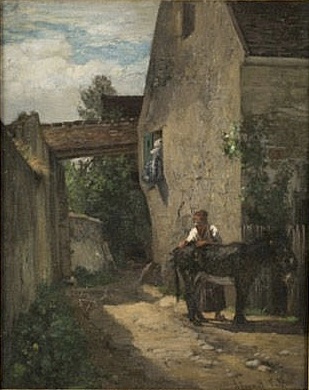
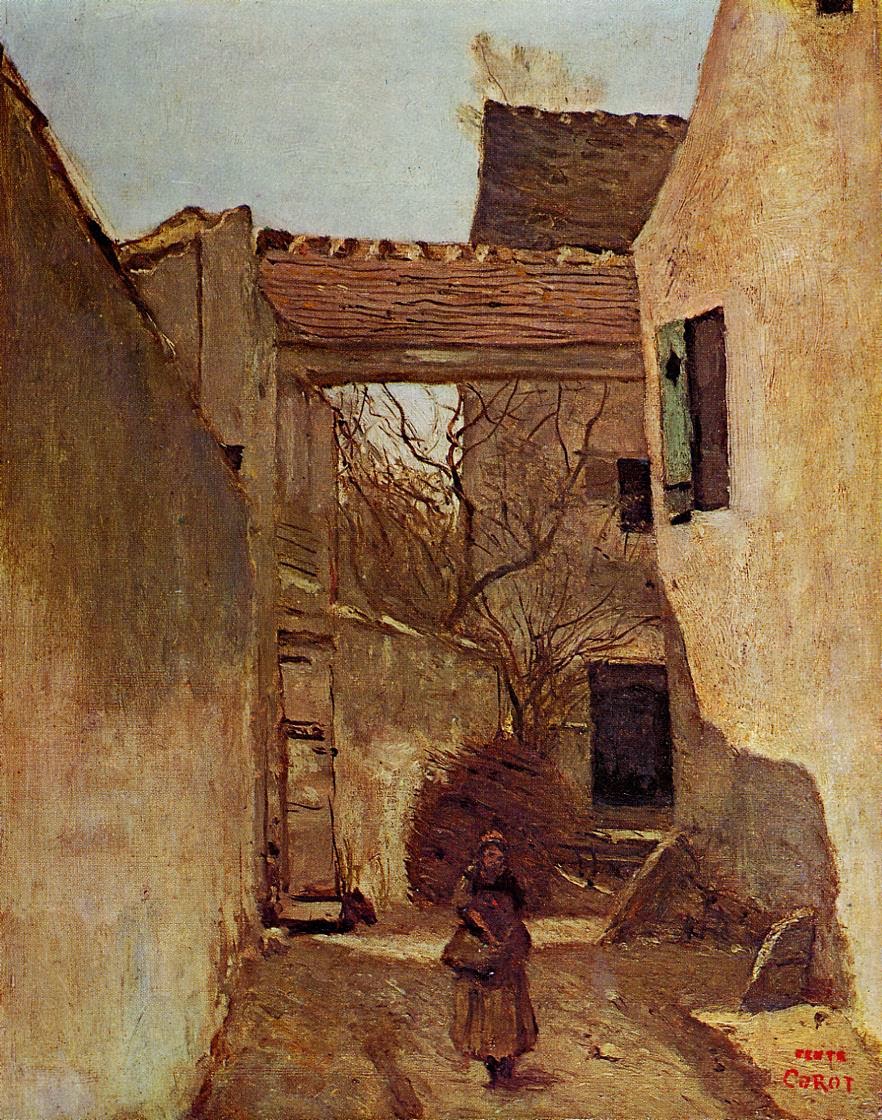
Two painters in the same street of Ecouen

It’s surprising to find out that two artists have painted the same location in the village of Ecouen.
One, very well known is Jean-Baptiste COROT (1796-1875). He painted, in the same area, the villages of Presles and Auvers-sur-Oise. He stayed three days in Ecouen.
The other, American, is Joseph Foxcroft COLE (1837-1892). We know of him several paintings of the Ecouen village. He lived there for several years, being part of the painters Colony.
Their common interest is the attraction for the countrymen and women, simple housing, poor locations as well as the people themselves, adults or children.
In their paintings, the colors are changing according to the seasons but the poetry remains the same.

Christian Dauchel